
Key takeaways
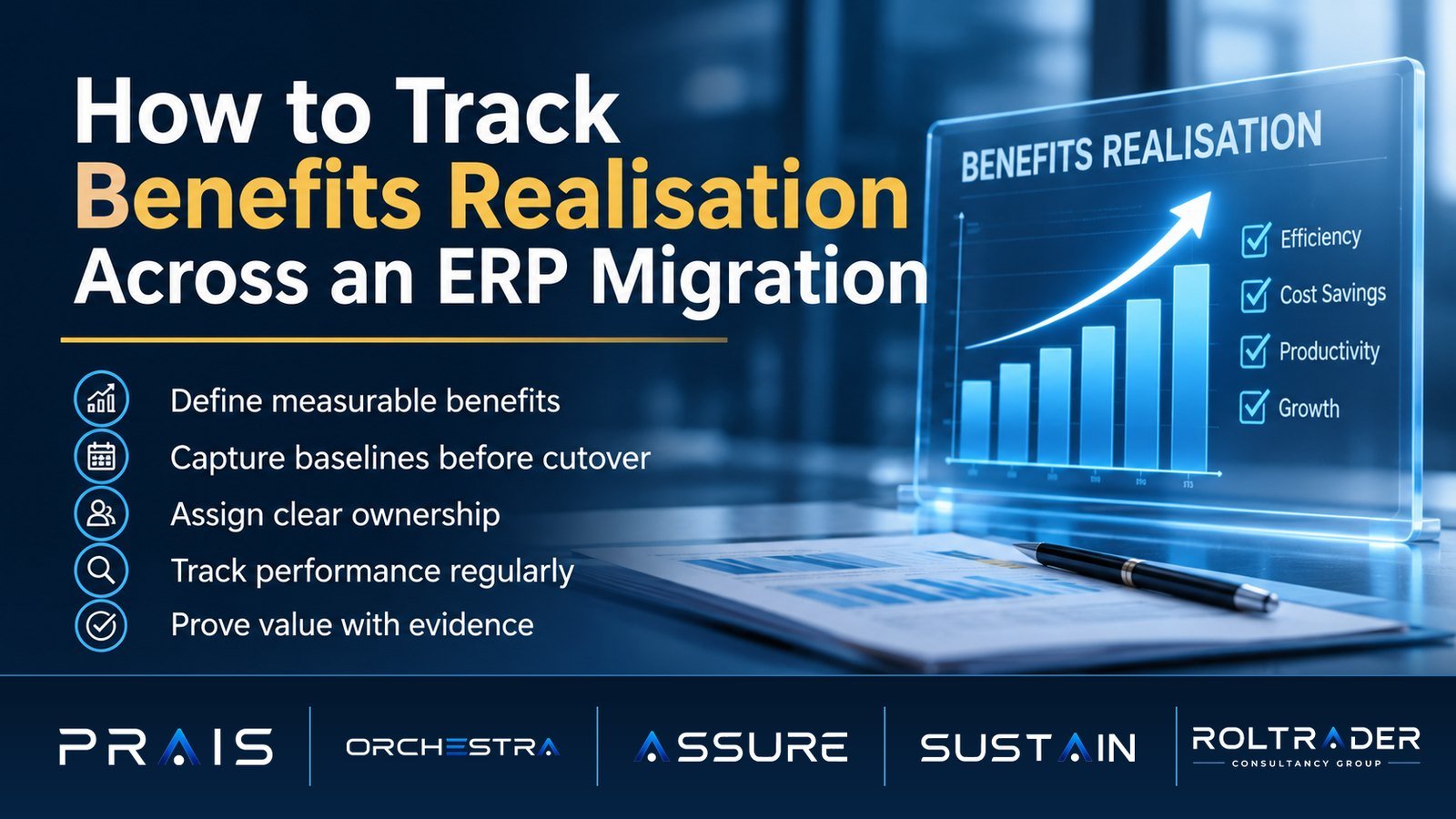
- Write every benefit as a five-field statement (metric, baseline, target, source, named owner) before the business case gate is approved.
- Capture baselines from the legacy system before cutover. Once migration starts, the pre-project process has already changed.
- Benefits belong to the business leaders whose budgets move, not to the programme director. Record the transfer of ownership at go-live readiness.
- Run the same benefits report at every stage gate. Let the variance set the status, not the person reporting it.
- A benefit closes only when an evidence pack shows the measured outcome against the baseline, accepted by the sponsor and, if financial, countersigned by the CFO.
- Roltrader's suite carries one promised figure from decision to close-out: PRAIS produces it, Orchestra holds the owners and decisions, Assure measures what lands, Sustain tracks whether it holds.
What does benefits realisation tracking actually involve day to day?
Benefits tracking is a monthly rhythm, not a document written once at business case stage.
The monthly cycle: measure, compare to baseline, explain variance. Each month, someone takes the actual value of each benefit metric from the system that owns the data: invoice volumes, headcount, working capital, licence counts. It is compared with the baseline recorded at business case stage, and the variance is explained in a sentence or two per benefit. HM Treasury's Green Book treats benefits management as a discipline run against a measured baseline, and warns of optimism bias in forecasts. The same discipline applies to an S/4HANA programme.
Why self-reported status is not measurement. Workstream RAG status measures confidence in delivery, not value delivered. A gate can be green while realised benefits sit at 40% of what was promised. In the Roltrader suite the two are kept apart: Orchestra's gates hold delivery evidence, and Assure's Value Realization view computes realised value against the promise. Keep them in separate columns in your own report too.
How do you define a benefit so it can be tracked later?
"Improve finance efficiency" cannot be tracked. "Reduce month-end close from 8 to 5 working days" can. A trackable benefit is a sentence with five fields, agreed before the gate that approves the business case.
| Field | What it captures | Example |
|---|---|---|
| Metric | The measurable quantity | Days to close |
| Baseline | Pre-project value, with source | 8 days, measured Apr to Jun |
| Target | Post-project value and by when | 5 days within 2 cycles of go-live |
| Source | Where the number comes from | SAP FI close cockpit |
| Owner | Named person accountable | Finance Controller |
Without the source, every gate review becomes an argument about whose spreadsheet is right. Without a named owner, the benefit is nobody's job.
How the suite holds this. PRAIS builds the business case from the client's own export and lists each benefit driver with its value and the reason. A driver without a captured baseline is not counted: it appears under "benefits not quantified", with the input it needs. In Assure, each benefit line records the measurement behind its baseline: the query or report, what it runs against, the baseline period, the baseline value and the unit, and whether the same measurement can be re-run after cutover. A line with no captured measurement reads "Undocumented", never green. Assure then reports how reproducible the whole set is: Audit-ready, Partly evidenced or Self-reported.
Baseline discipline: capture before you cut over. The most common failure is measuring the baseline after migration starts. Capture it from the legacy system first, and write down the exact measurement so it can be run again on the new system.
Worked example: three benefit statements for an S/4HANA migration.
- Reduce month-end close from 8 to 5 working days, measured in SAP FI, within two cycles of go-live. Owner: Finance Controller.
- Cut DSO from 52 to 45 days, measured from the AR ageing report, within six months. Owner: Head of Credit.
- Retire three legacy finance interfaces, verified in the integration inventory, at hypercare exit. Owner: Integration Lead.
Each can be proved or disproved at a gate.
Who should own each benefit and when does ownership transfer?
Why the programme director should not own benefits. The programme director owns delivery, not outcomes. If the same person reports status and owns the benefit, self-reported status becomes the baseline. Benefits belong with the leader whose budget moves: headcount with the operations director, working capital with the CFO, licence cost avoidance with IT asset management.
The transfer point. The handover happens at go-live readiness, not hypercare exit. Each benefit needs a written transfer record: baseline value, measurement method, receiving owner and first review date.
How the suite holds this. Orchestra records decisions with a named decider, the rationale and the date. A change is a new entry that supersedes the old one, and the history stays. That is where benefit ownership and its transfer are recorded. Sustain shows who owns each capability a benefit depends on and how often it is reviewed; a capability with no owner reads UNOWNED, and an overdue review reads REVIEW-OVERDUE, rather than disappearing. The AMS transition gate asks for a named owner for every in-scope capability and a service baseline before handover is accepted. The client names the owners; the suite records them and shows when one is missing.
What does a benefits realisation report look like at each stage gate?
The same report runs at every gate. Changing the format mid-programme is how baselines get quietly renegotiated.
Columns. Each row is one benefit from the business case, not a workstream: benefit and description; baseline and source; owner at this gate; expected at this gate; realised to date; variance and reason; status; action or decision required. Two rules keep it honest. Status comes from the variance, not from the owner's view. Every amber or red names evidence an independent reader can check.
How the suite does it. Assure's Value Realization compares each benefit's promised annual value, taken from the PRAIS business case, with the client's captured actuals, annualised. It does not compare against the full-year figure on day one. It compares against the value expected by that point on the benefit's own ramp. Realised divided by expected-to-date sets the status, using fixed bands: Ahead at 105% or more, On track from 95%, Lagging from 80% (amber), At risk below 80% (red). A benefit not yet due reads Not yet due. A working-capital line sits beside the benefit lines.
Worked example, illustrative. Inventory baseline £4.2m, measured from the SAP extract at business case approval. Owner: supply chain director, transferred from the finance lead at blueprint. Expected released by the go-live gate: £1.1m. Realised from the same extract run the week before: £0.4m. That is 36% of what was expected, so the status is At risk (red), set by the number. The reason is recorded: two warehouses are still on legacy processes pending the second wave. The decision required is to re-forecast to second-wave go-live plus one quarter, or accept a permanent shortfall in the case. The steering committee decides, and the decision goes into Orchestra with its rationale and the date.
What changes at each gate. At the business case and design gates, every benefit carries its baseline, owner and forecast. After go-live the realised column fills in. Where the gap between expected and realised persists across two gates, treat it as a delivery confidence signal, not a reason for another optimistic re-forecast.
How do you handle benefits that slip, shrink, or get claimed by another project?
Variance is normal. What matters is whether the rules for re-baselining, de-duplication and retirement were written before the variance appeared.
Re-baselining. Any change to a benefit's target, timing or baseline goes to the steering committee with the original number, the new number and the reason. The sponsor approves slips under an agreed tolerance; larger ones go to the board. Re-baseline once, with an audit trail. Repeated re-baselining is itself a warning sign. Orchestra's decision log keeps the original and the superseding entry side by side.
Double counting. When two projects claim the same saving, the realised total is fiction. Keep one benefits register with one owner per benefit, and require any new project to cross-check it. In the suite's AI net benefit view, Sustain tests for a licence reduction already counted as cash, and values released capacity only as a commitment with an owner, what the hours become and by when, tracked as kept, partly kept or not kept.
Retiring a benefit. If a benefit has slipped twice, shrunk below tracking materiality or been absorbed into business as usual, retire it formally: the decision, the reason and the value given up. Record it as a decision. Silent abandonment is what audit committees find.
Which tools and data sources do you need to track realisation without manual spreadsheets?
Source data. Realisation numbers should come from where outcomes already live: transaction data for cycle times, the finance ledger for cost, HR data for headcount, licence and contract records for run cost.
Four tests for any tooling. Does it take figures from the client's own data rather than re-keyed slides? Does it compute against a baseline agreed before go-live? Does it show its method? Does it produce evidence an audit committee can inspect? Ask any provider how the numbers get in.
How the suite answers. It works from the client's own exports and captured actuals, and it is point in time, not a live feed. The promised figure comes from the PRAIS business case itself, not retyped in a later tool; Sustain inherits it from the PRAIS baseline and shows whether the evidence was signed. Client-captured actuals are shown as the client's own, and a baseline that cannot be re-run reads Self-reported. The method is printed with the result, and a gap reads "Not captured", never green. It does not replace the finance team's ledger reconciliation, and the judgement at each gate stays with the people accountable.
What spreadsheets are still fine for. Drafting benefit definitions, logging owner transfers and one-off sensitivity checks. They fail when they become the system of record, because version drift and selective updates keep amber-for-show reporting alive.
How do you close out a benefit and prove realisation to the steering committee?
The close-out evidence pack. A benefit is not closed when the delivery partner says so. It is closed when the evidence shows the measured outcome against the baseline agreed at business case stage. The pack holds four items: the original definition with metric and baseline; the post-go-live measurement from the system of record; a variance explanation if realised differs from forecast; and the owner's confirmation that ownership has transferred and no other programme claims the benefit. One page each.
Who accepts. The sponsor accepts a benefit as realised against the pre-agreed metric and records it at the gate. The CFO countersigns anything financial. Acceptance is binary: measured, owned, baseline-verified, or not closed. These are the client's decisions.
What the suite adds. Assure's Value Realization view and its evidence output give the pack its numbers: promised against expected-to-date against realised, the measurement behind each baseline and whether it can be re-run, with the method shown. The suite records and shows. It is the client's accountable people who accept and countersign, and Orchestra keeps that decision on record.
FAQ
When should benefits realisation tracking start: before or after go-live? Before, at business case stage. Baselines must be captured before cutover, because once migration starts the "before" figure is gone. The first gate review should already carry each benefit's baseline, owner and forecast.
How is benefits realisation different from benefits management? Benefits management is the monthly rhythm: take actuals, compare to baseline, explain variance. Realisation is the judgement at a gate or at close-out that a measured outcome has been achieved. Management is the rhythm; realisation is the acceptance decision it supports.
Who accepts that a benefit has been realised? The sponsor accepts it against the agreed metric and records the decision at the gate. The CFO countersigns anything financial. Acceptance is binary: measured, owned, baseline-verified, or not closed.
What percentage of business case benefits actually gets realised? There is no defensible universal figure, so be wary of any precise percentage you are quoted. Track your own programme's gap between expected and realised across two consecutive gates; that trend is your real delivery confidence measure.
Can benefits realisation be tracked for a RISE with SAP migration? Yes. Licence and contract records give the run-cost baseline, transaction data gives process measures and the finance ledger gives cost. The same five-field statements and gate cadence apply. In the suite, PRAIS reads licence usage and models exposure from the client's own numbers; modelled bands are never a vendor quote.
Does this work on platforms other than SAP? The method applies on any ERP. This article uses S/4HANA, where the suite is deepest; Dynamics 365, Oracle and Workday are assessed from the client's exports.
The Roltrader suite: PRAIS decides, Orchestra runs, Assure proves, Sustain drives. It records and shows the evidence under your own judgement. A walkthrough is available on request. How we handle your data: roltrader.com/privacy.html